Thursday, 2 February 2017

> Inscription on the Mihrab of Masjid Al Aqsa

Original inscription from Salahuddin Ayyubi's era

Arabic is as below,
أَمَر بتجديد هذا المحراب المقدَّس وعمارة المسجد الأقصى، الذي هو على التقوى مؤسَّس – عبدُالله، ووليه يوسف بن أيوب أبو المظفر الملك الناصر صلاح الدنيا والدين عندما فتحه الله على يديه سنة 583هـ، وهو يسألُ الله إذاعة شكر هذه النعمة وإجزال حظِّه من المغفرة والرحمة

Translation goes as below,

The work of the renewal of this sacred Mihrab and building of Masjid Al Aqsa is based on piety. Founder – slave of Allah and its (Masjid’s) guardian Yousuf Bin Ayyub abdul Muzaffar King Nasser Salah of world and religion (Salahuddin wa Duniya), when Allah opened (Masjid) on his hands in 583 AH, and he (Salahuddin) prays to Allah to spread gratitude of this blessing, and reward him plentiful share of His forgiveness and mercy.

Thursday, 12 January 2017

> Crossing from Jordan into Israel


While crossing via King Hussein Border into Israel, we make 2 pit stops - one in Jordan and one in Israel itself. 

Jordan King Hussein Border crossing offices are located in Jordan valley just over 46 kms west of Amman.  Allenby Bridge is further 5kms, where Israeli border offices are located.

Jordan Stop:

All 3 buses stopped - and our passports were collected. Our local guides from  took all passports on our behalf to offices nearby. Scene was a bit chaotic, I saw many buses tugging away luggage trolleys - am not sure which direction they were moving. It took us good 2 hrs before our passports were returned and we were allowed to leave. Cafeteria was basic and amenities were poor. It seems delay was due to Jordanian border officers taking longer than usual tea / smoking break.


Allenby Bridge - Israeli Border:

After a short drive , we crossed unimpressive Allenby bridge overr dried up Jordan river, to enter enclosure of Israel border crossing. It is protected by security cameras and electric barbed wires. Buses had to stop at various swing gates before we could disembark.

My recollection of Israel Crossing at Allenby bridge


  • Step1 - Luggage Check in: Take your luggage and go to first counters to get security tags (ditto to airport check in tags), take one for each bag to check in. You need to show your passport, and they put a white sticker at back cover of the passport with a bar code and mention of number of bags. It's a bit chaotic and there is no lane discipline, space is cramped because other queues occupy most of check  in area.  Put tags on luggage and drop it on belt. Carry your light luggage and join a nearby queue for next check. Buses from Jordan will now return - so ensure you leave nothing back in the buses. All transport after successful crossing is Israeli.

  • Step2 - Passport Check: There are 3 windows, and all they do here is to check your passport and put a small blue sticker with some numbers below the white check-in sticker at back of passport. No courtesy is shown by staff and at times people may be made to go to back of the queue if they try to hurry or touch swing gate barrier. A man in front of me what sent back as he tried to push open the barrier. I saw an old lady crying, shouting and pleading to security guys near the counter - I could not understand what was the matter as it was in Arabic.


White Sticker put while Checking in, while blue at passport check


  •  Step3 - Security check: Typical airport security, but no restriction to put liquids in clear bag. Keep your passport with you and put all belongings on trays for scanning. I walked too fast through security gate, so was made to walk 2-3 times - very slowly. Passport is checked again to match your photo and you can collect your belongings once on the other side. I saw a few ladies being taken for additional security check behind the curtains- there was female security staff.

  • Step4 - Visa on Arrival : After you leave security area, you come to a small space where toilets are located. They looked cleaner compared to those in Jordan.  Adjacent to toilet is a small shop selling refreshments. They accept all sort of currencies, guy who worked there was friendly. Then you enter a large hall on your right where you join one of the queues. Staff at the counters looked tired and frustrated - a lady officer was upset because people were double queueing. You go and show your passport, if you are lucky - a few questions and you will get the visa and leave, but if you are lucky enough to be young (18-45 yrs) or unlucky old , your passport will be taken and you will be handed over a form (which is a poor photocopy) to fill and go to waiting area. You fill the form and this is where the wait starts. WiFi is free - but I chose not to connect. Air conditioning ducts looked improvised, and were of cloth tubing with holes.  Every now and then a blast of air inflated them drawing attention of people arriving. There are a few outcomes possible from here,

    • Outcome 1: No further questioning, and your passport along with visa will be returned by officer calling your name. In our case, our group leader was around so he was making sure all names are called out from our group who were waiting there.
    • Outcome 2: You will be called for further questioning into a separate area, which can be typical grilling at any country who wants to ensure travellers are no threat to their security. Then you will be given visa and let go. Waiting can be hours in some cases. In both cases above, a visa card is issued which is typically valid for 3 months from date of entry. You don't need to ask officers not to stamp your passport, they already know it - and may even get irritated if you remind them.


Visa provided on a separate paper


    •  Outcome3: Worst case, you may be sent back for any reason deemed appropriate by immigration / security staff.

  •  Step5 - Luggage collection: Luggage will be put in neat lines , you can leave once you collect yours - you may be asked to show passport/ visa on the way to exit. I wasn't asked any question myself though.

  • Step6 - Exit: load your luggage on the bus waiting in parking, and you can leave when bus is ready.
Worth noting that there is no visa fee to enter Israel - however there is a departure tax, which I will talk about in a later post under 'Crossing from Israel into Jordan'


Thursday, 5 January 2017

> A Fragrance to Remember

(This post is related to very first post on this blog -  http://jerusalempractical.blogspot.co.uk/2016/12/chasing-fragrant-grave-of-muadh-bin.html )

I originally wanted to use bus for my visit to grave of Muadh Ibn Jabal in North Shuna, but was advised by Amin Kawar representative who met me at the Queen Alia airport to hire a taxi instead to save time. Reached hotel in central Amman in early hours of Christmas.
Staff at Blue Marine hotel  was very welcoming and friendly. Receptionist Muhammad promised he would inquire about taxi fare and call me 7:30am in the morning. Sharp at 7:30am I received call in my room about booking. Taxi driver spoke English and was happy to take me to North Shuna at a good price. I agreed to be picked up at 9am. Taxis in Amman are perfectly safe, and enjoyable experience. You are welcome the moment you step in and if you are keen you will enjoy a nice talk with the driver. Most of the taxi drivers in Amman are Palestinians, who were either born on the other side of Jordan river or their parents migrated to Jordan fleeing atrocities of occupation.
Taxi driver was Taariq, a middle aged Amman resident, a relaxed and composed man who had four kids. He spoke English and we were communicating effortlessly. He said there are many universities in Jordan and national literacy is high. He showed me sprawling premises of Medical University buildings on the right side of the road. North Shuna is 100 kms north of Amman and most of the road we took went through fertile Jordan valley. Weather was cold and cloudy. Views on the way were breathtakingly beautiful. What immediately caught my attention was the landscape looked so ancient - the colours and texture of the rocks made me believe  as if Moses would just appear with his followers.
View of Mountains Leading into Jordan Valley

On our way we stopped at a place reported to be final resting place of Yusha ibn Noon (Prophet Joshua) , who is believed to be young companion of Moses when he travelled in search of wise man Khidr (story narrated in Surah Kahf).  My arrival timed well with the keeper of tomb chamber opening the door for other group. Keeper there gave me a brief on Yusha's history. Keeper said he himself came from family of Tamim Al  Dari who was Prophet Muhammad's companion. After a brief stop there, we started our descent into the Jordan valley, it was here I caught first glimpse of the mountains of holy land.

Reported Grave of Yusha Ibn Noon with keeper who is from family of Tamin Al Dari


Entry to reported grave of Yusha Ib Noon

On the way up North, we stopped at the tomb of Abu Obaida Ibn Jarrah - who led successful conquest to this part of the world , then called as 'Bilaad U Shham'. Masjid there is large and beautiful with an impressive dome and towering minaret. Colour of the stone is soothing to eye and is from local quarries. Water in wudu fountain was very cold. His grave is clad with marble and is behind a glass curtain. I met a few locals there who stood up to welcome me, and were very happy to see me coming from the UK. People are the best thing about Jordan, without a shred of doubt the most friendly I met.  I prayed in masjid before we resumed our journey to further north.
View of Wudu Fountain in courtyard of Masjid of Abu Ubaida Ibn Jarray
On the way , my driver kept stopping every now and then to check fresh produce from Jordan valley. He was keen on buying oranges - one box full cost only 1.5 JOD he said, just a fraction of city price. When we reached North Shuna it was raining heavily. I prayed Zuhr with Jamaat, but didn't realise they combined it with Asr due to heavy rains. I left after Zuhr - which meant I got a few minutes all alone in tomb chamber of Muadh Ibn Jabal's while rest prayed Asr. I felt that was a special arrangement from Allah to allow me some privacy. I cleared my nostrils and with great anticipation, I looked into the tomb chamber from outside through the door and could his grave covered in dark green velvet cloths. Expectation was high, and I had a few candidate  smells in my olfactory imagination. Took off my shoes, and with very first step into the chamber, I was hit on the face by a whiff of the most beautiful Oudh perfume. Like of which can only be found in the most expensive Oudh perfumes from French niche lines, only that it was richer than any that I had smelled before. A big smile came on to my face- I kept sniffing, harder with every breath, as if smell would disappear or become weak. There are two graves in the chamber, one near the door is that of Muadh Ibn Jabal, and towards far end of the chamber is his son Abdur Rahman bin Muadh's. Both of them died from plague of Amwas (started in 639AD)which claimed lives of thousands of people.  Having used perfumes all my life, I can tell the difference between natural and artificial smells , also whether smell is one of opening, middle or dry down. I could tell with reasonable certainty it was natural perfume with layers of complexity - bouquet of amber, rose, carnation and musk - wrapped beautifully around rich body of Oudh in the middle. I sniffed walls, green velvet cloths on this grave, windows , door - there was no trace of any smell on anything. Smell was just hanging in the middle of the air. I noticed it was strongest near the door, to right side where his head is. I could smell the same near his son's grave but it was not as strong, or perhaps I was immune to its strength after spending some time inside the chamber.
Muadh Ibn Jabal died in 18 AH, at age of 38 years


View of structure over his grave, smell is strongest where wooden name plate is on the grave


Tomb Chamber Visible in distance


View Outside Masjid


General View of tomb Chamber
After spending a few minutes there, I went outside to call in Taariq to show him the miracle of Allah. He had come to Shuna before, but didn't go inside the chamber.  As he entered, his first reaction was of amazement and disblief. As I was trying to convince him that it indeed was natural, a middle aged man entered the chamber - he was Jamil, smiling muezzin at the masjid for 10 years. He provided a very beautiful summary of who Muadh ibn Jabal was, and why he came here. He spoke in Arabic and Taariq translated every line for me. For a second I felt the scene was from a documentary video. Jamil said he has been visiting the place since he was a child, and assured us that the perfume in the chamber hasn't changed a single bit. He said it is particularly strong in the evenings. And of course to my question if someone put perfume there secretly, he looked into my eyes and simply said,  'no one puts perfume here, it comes from the grave'.  He said that graves of the companions of Prophet Muhammad who died in Amwas plague emanate same smell. Unfortunate that Abu Ubaida's grave is behind a glass curtain - so I could not witness it first hand.  Thought that immediately came to me was to write to famous perfume houses to send someone here to recreate the smell and name it after Muadh Ibn Jabal. I was taking a blessed feeling away, and a memory of fragrance that will remain in my imagination forever.
On the way back, rain got even heavier. Condition of the roads is pathetic but villages are full of life.  Once we were ascending towards Amman from Jordan Valley, fog was so thick that only reference for us was faint taillights of cars ahead of us. On our way back, Taariq stopped at 4-5 places to buy absolutely fresh Jordan Valley produce, there were oranges, lemons, cucumbers, radishes and many other varieties in boot of taxi- which I was sure would last him for weeks.

Monday, 5 December 2016

> Gates of Al-Aqsa Sancturay

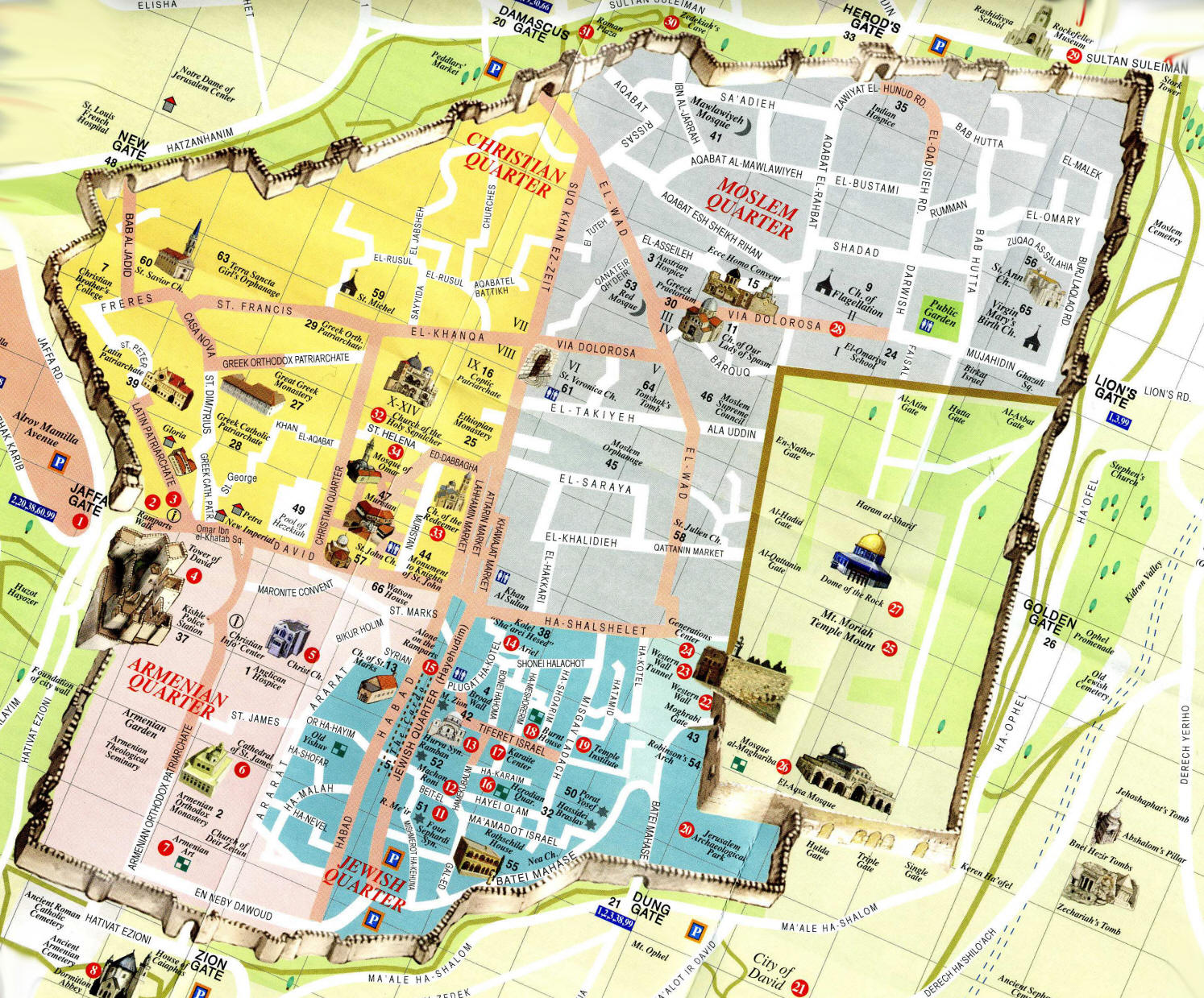
Like in old days they said all roads led to Rome - I was advised all streets in the old city of Jerusalem lead to Al-Aqsa.  I managed to overlay some details of various gates and places of interest in the Al-Aqsa sanctuary.Gates which are underlined are open to Muslims. Gates not underlined are sealed permanently. Maghriba Gate/ Moroccans gate is for non-Muslims. I also found site below extremely useful for details of various places of interest scattered around Al-Aqsa.


http://www.biblewalks.com/Sites/TempleMount.html


Sunday, 4 December 2016

> Chasing the Fragrant Grave of Muadh Ibn Jabal

I got inspired by narration given by Maulana Tariq Jameel of a pleasant fragrance emanating naturally from the grave of Muadh Ibn Jabal (Rz). I will have an opportunity to visit Jordan in Christmas time en route to Jerusalem - focal point of our tour. Since I will be getting a free day in Amman on the Christmas day, I wanted to visit his grave to experience the smell first hand. In his speech, Maulana Tariq spoke of it to be near Irbid in Jordan, but he didn't give exact location where it was. English language google search did not give location, but found it using Arabic search on google.


General View of Tomb, inset - Structure on Grave
Source: Photobucket of Saiful Islam's (ahmsaifulislam) 

His grave is located in town of North Shuna , 26km North west of city of Irbid in Jordan. Exact location is Latitude: N 32.60320222 Longitude: E 35.61479509.


Something about Muadh Ibn Jabal Rz.

Credit for below: http://www.islamiclandmarks.com/

Muadh (may Allah be pleased with him) was an Ansari who became a Muslim at a young age at the hands of Musayb-bin-Umair (may Allah be pleased with him), whom the Prophet (peace and blessings of Allah be on him) had sent to Yathrib (Madinah) before the Hijrah. When the Prophet (peace and blessings of Allah be on him) reached      Madinah, Muadh stayed in his company as much as possible. He studied the Quran and the laws of Islam until he became one of the most well-versed of all the companions in the religion of Islam. Wherever Muadh went, people would refer to him for legal judgements on matters over which they differed.

Sometime after the Prophet (peace and blessings of Allah be on him) had returned to Madinah, messengers of the kings of Yemen came to him announcing that they and the people of Yemen had become Muslims. They requested that some teachers should be with them to teach Islam to the people. For this task the Prophet (peace and blessings of Allah be on him) commissioned a group of competent da’ees (missionaries) and made Muadh-bin-Jabal their amir. He then put the following question to Muadh: “According to what will you judge?”. “According to the Book of Allah,” replied Muadh. “And if you find nothing therein?”. “According to the Sunnah of the Prophet of Allah.”. “And if you find nothing therein?”. “Then I will exert myself (exercise ijtehad) to form my own judgement.” The Prophet (peace and blessings of Allah be on him) was pleased with this reply and said: “Praise be to Allah who has guided the messenger of the Prophet to that which pleases the Prophet.” The Prophet (peace and blessings of Allah be on him) personally walked for some distance alongside Muadh as he rode out of the city. When it came time to bid farewell the Prophet (peace and blessings of Allah be on him) said to Muadh, “O Muadh, perhaps you shall not meet me again after this year. Perhaps when you return you shall see only my mosque and my grave.” Muadh (may Allah be pleased with him) wept upon hearing this as he knew in his heart that he was never to meet the Prophet (peace and  blessings of Allah be on him) in this world again. A feeling of sadness and desolation overtook him as he parted from the Prophet (peace and blessings of Allah be on him).


The Prophet’s premonition was correct, the eyes of Muadh (may Allah be pleased with him) never beheld the Prophet after that moment. The Prophet (peace and blessings of Allah be on him) died before Muadh returned from Yemen. Muadh (may Allah be pleased with him) died in Jordan during the 18th year after Hijra, at the age of 38. His son is also buried close to him.


Source: http://www.islamiclandmarks.com/